Chris Aniszczyk recently talked in his blog about how the barriers for contributors could be lowered. One of his topics was "how about us making it easier for users to file bugs?"
He then talked about a feedback agent included in Eclipse.
I think that's quite a good idea. Especially when an unhandled exception appears somewhere inside Eclipse, it would be great to have a new GUI dialog to add this exception to a new bug message.
What I have in mind is that each time a severe exception happens, then it can either be added to the Eclipse log or (maybe as an extension of the logging mechanism) is displayed in an error window to the user (the developer can decide that during design-time). The user can see a user-friendly message (Please *not* the exception message itself!) and can then decide to click on a button whether to report this bug (similarly as Microsoft Windows offers his users to do so, but I don't know anybody who ever klicked on "Report this bug to Microsoft").
If the user agrees and clicks on this button, then another window shows up that allows the user to specify what exactly he had done before. The window automatically suggests the top-level-project, project and component where this bug should be added to and fills in all the platform details and adds the stacktrace of the exception. Maybe with an integration of Mylin also the context of work could be added automatically.
That would probably make it easier for users to give us feedback about bugs, but it would also make it easier for the contributors of a project to find out whether two bugs are similar (since the stacktrace is automatically added to the bug message, too, and can easily be compared).
Maybe that would be another feature that could be added to e4?
Mittwoch, 15. Juli 2009

Mittwoch, 24. Juni 2009
JWT 0.6 released
Today, as part of Galileo, the newest release of JWT, the Java Workflow Tooling project, has been released. Java Workflow Tooling in version 0.6 brings open business process design and development to the Eclipse platform. JWT-modeled processes can look the way the analyst wants, hold any implementation information the developer adds in, and be deployed to the runtime platform of choice.

Come and get it!
This is possible thanks to a flexible framework allowing extensible views, model and transformations, that communities and vendors can build on. JWT comes with several built-in extensions like UML Activity Diagram or Event-driven Process Chains (EPC) views, BPMN interoperability, code generation (e.g. XPDL, or WSBPEL-code in the AgilPro integration, but also HTML documentation). There are actually already a few solutions that integrate JWT, such as the SOA-focused Scarbo of the OW2 consortium, or AgilPro in SourceForge.
JWT is available in Galileo using Help -> Install New Software... -> Galileo -> General Purpose Tools -> Java Workflow Tooling (Incubation).
Come and get it!
Mittwoch, 17. Juni 2009
Everything prepared for Galileo
Last night I fixed the last bug for Eclipse Galileo. Just in time! Today the release candidate RC5 is built for version 0.6 of our project Java Workflow Tooling (JWT) and this release candidate will be used in the final Eclipse Galileo build. You'll find JWT on the Galileo update server in the area General Purpose Tools.
But this doesn't mean that we'll now have time to rest and lie in the sun. Now is the time to summarize the development in JWT of the last months in a few sentences for articles and blogs. It's also the time to plan ahead: how shall the project plan for the next years look like? Which releases will we have and how will the general strategy for e4 as well as beyond look like?

In addition to that there are also integrators of JWT that need to be updated with the new version. In our SourceForge project AgilPro we have a toolsuite that allows to model, simulate and execute workflows. It includes all the plugins (e.g. workflow editor but also several transformations) from the JWT Galileo release.
In addition it also contains the Workflow codegeneration framework which allows us to transform the graph-based to a block-based structure in order to generate BPEL-code (1). So we are just updating and adapting everything until next week in order to have hopefully a joint release of Galileo and AgilPro.
(1) I know that BPEL is not only a block-based language, but can also be used graph-based. But the block-based structure is much better to read and maintain in BPEL-editors.
But this doesn't mean that we'll now have time to rest and lie in the sun. Now is the time to summarize the development in JWT of the last months in a few sentences for articles and blogs. It's also the time to plan ahead: how shall the project plan for the next years look like? Which releases will we have and how will the general strategy for e4 as well as beyond look like?

In addition to that there are also integrators of JWT that need to be updated with the new version. In our SourceForge project AgilPro we have a toolsuite that allows to model, simulate and execute workflows. It includes all the plugins (e.g. workflow editor but also several transformations) from the JWT Galileo release.
In addition it also contains the Workflow codegeneration framework which allows us to transform the graph-based to a block-based structure in order to generate BPEL-code (1). So we are just updating and adapting everything until next week in order to have hopefully a joint release of Galileo and AgilPro.
(1) I know that BPEL is not only a block-based language, but can also be used graph-based. But the block-based structure is much better to read and maintain in BPEL-editors.
Donnerstag, 28. Mai 2009
Article about JWT in Eclipse magazine

If you are interested in process modeling or workflow execution, you might want to have a look in the newest German-speaking Eclipse magazine ("eclipse Magazin"). In their current issue there is an article called "Geschäftsprozesse ausführen mit Eclipse JWT". It reports about the latest progress of the Eclipse Technology project Java Workflow Tooling (JWT).
If you want to learn more about this project, please don't hesitate to contact the mailing list or the newsgroups.
Donnerstag, 7. Mai 2009
JWT and Galileo M7
Yesterday our milestone M7 for the Galileo release of the Java Workflow Tooling (JWT) project has been finalized and published. As we are part of the yearly release train we are bound to the deadlines of Galileo. Please find the milestone build either on our JWT stable update site or on the Galileo staging repository.
 JWT allows you to model your workflows (e.g. starting with the STP BPMN editor), to generate code in XPDL, jPDL or other languages out of your model and deploy that code to a workflow engine. Thereby, the workflow editor provides you with different views on your process (different icons, figures, names, etc.).
 We built and tested JWT against Galileo M7, EMF 2.5 and ATL3.0 as well as with Ganymede, EMF 2.4 and ATL2. At the beginning we were facing some problems with ATL3, but thanks to our committers from Obeo and OpenWide, these problems have been resolved.
The M7 was the freeze date for our release, so we won't make any more changes on the features, UI or API any more, but will still work on some bugs that we are currently aware of. Please feel free to try the newest release and give us some feedback or report any issues, enhancement request or feature request on Bugzilla.
If you are new to JWT, but would like to know more about the project without downloading the newest release right now, please feel free to have a look at these slides that have been presented at Eclipse Forum Europe or at this screencast from EclipseCon.
 JWT allows you to model your workflows (e.g. starting with the STP BPMN editor), to generate code in XPDL, jPDL or other languages out of your model and deploy that code to a workflow engine. Thereby, the workflow editor provides you with different views on your process (different icons, figures, names, etc.).
 We built and tested JWT against Galileo M7, EMF 2.5 and ATL3.0 as well as with Ganymede, EMF 2.4 and ATL2. At the beginning we were facing some problems with ATL3, but thanks to our committers from Obeo and OpenWide, these problems have been resolved.
The M7 was the freeze date for our release, so we won't make any more changes on the features, UI or API any more, but will still work on some bugs that we are currently aware of. Please feel free to try the newest release and give us some feedback or report any issues, enhancement request or feature request on Bugzilla.
If you are new to JWT, but would like to know more about the project without downloading the newest release right now, please feel free to have a look at these slides that have been presented at Eclipse Forum Europe or at this screencast from EclipseCon.
Montag, 27. April 2009
Summary JAX, SOACON, Eclipse Forum Europe
Did you have the chance to visit this years JAX? I thought it will be mostly about Java-related technologies. Surely, I have already heard about Scala, Rails, Groovy or JRuby, but the huge amount of different programming languages that exist nowadays and that were presented there, really overwhelmed me!
Have you already heard about F#, Newspeak, Fortress or Boo? At least, I didn't. What Markus Voelter explained in his talk about Trends in Languages 2009, was that Scala on the one side is an approach that combines an object-oriented language with ideas from functional programming. F# on the other side is the .NET derivate of the JVM-based Scala and goes the other way round: it extends a functional programming language with object-oriented concepts.
Newspeak is a further development of Smalltalk and Fortress improves Fortran. The language with the probably most interesting name (besides BrainFuck) is Boo, an object-oriented statically typed programming language.

With all these languages it's quite hard for any newcomer to understand which language to use in when situation and whether it has advantages or disadvantages in some areas. So, if you have some document that explains the difference between Ruby, JRuby, Groovy, Rails, Grails, Scala and all the others, I would be happy if you could share it! For me it seems that the box of Pandora has been opened again. A while now we only had one programming language besides .NET and that was Java. Now the pendulum points to the other side again (as Markus Voelter explained) and we have lots of different languages. We'll see how long this pendulum stays there and when it will go back again (which I think it will!) - whether it will go back to Java or a completely different programming language - nobody knows!
Besides these languages (that were presented in several talks and keynotes), JAX offered a lot of other interesting topics of course. Since it was combined with SOACON and Eclipse Forum Europe there had been a lot of talks about Eclipse, SOA and BPM which I attended.
Of course, I also had my own talk about how to execute process models where I showed some screencasts (1,2,3,4). Alas there had only been few people in the talk, but the feedback that I got from persons or via different mailing list showed that the interest of the community is there.
Most important (as always) are discussions with other people working in the same area. Here, I met quite a lot of interesting people from different companies that are also concerned about "How do I execute a model?", "What advantages does BPMN 2.0 have?", "How can I use UML for modeling an enterprise?", "Can aspect-oriented modeling assist me in my work?", etc. These discussions where really fruitful and I'm looking forward to some more on PlanetEclipse, my personal blog or maybe also our JWT mailing list.

If you want to read more about JAX, please also have a look at JAXEnter where several people blogged about their experiences in the last few days. You can also find some blog messages which I have written there, too. Als for all English guys, but they are only available in German!
With more than 1,700 attendees, it was really a successful conference and I'm already looking forward to next years JAX or this years W-JAX!
Have you already heard about F#, Newspeak, Fortress or Boo? At least, I didn't. What Markus Voelter explained in his talk about Trends in Languages 2009, was that Scala on the one side is an approach that combines an object-oriented language with ideas from functional programming. F# on the other side is the .NET derivate of the JVM-based Scala and goes the other way round: it extends a functional programming language with object-oriented concepts.
Newspeak is a further development of Smalltalk and Fortress improves Fortran. The language with the probably most interesting name (besides BrainFuck) is Boo, an object-oriented statically typed programming language.

With all these languages it's quite hard for any newcomer to understand which language to use in when situation and whether it has advantages or disadvantages in some areas. So, if you have some document that explains the difference between Ruby, JRuby, Groovy, Rails, Grails, Scala and all the others, I would be happy if you could share it! For me it seems that the box of Pandora has been opened again. A while now we only had one programming language besides .NET and that was Java. Now the pendulum points to the other side again (as Markus Voelter explained) and we have lots of different languages. We'll see how long this pendulum stays there and when it will go back again (which I think it will!) - whether it will go back to Java or a completely different programming language - nobody knows!
Besides these languages (that were presented in several talks and keynotes), JAX offered a lot of other interesting topics of course. Since it was combined with SOACON and Eclipse Forum Europe there had been a lot of talks about Eclipse, SOA and BPM which I attended.
Of course, I also had my own talk about how to execute process models where I showed some screencasts (1,2,3,4). Alas there had only been few people in the talk, but the feedback that I got from persons or via different mailing list showed that the interest of the community is there.
Most important (as always) are discussions with other people working in the same area. Here, I met quite a lot of interesting people from different companies that are also concerned about "How do I execute a model?", "What advantages does BPMN 2.0 have?", "How can I use UML for modeling an enterprise?", "Can aspect-oriented modeling assist me in my work?", etc. These discussions where really fruitful and I'm looking forward to some more on PlanetEclipse, my personal blog or maybe also our JWT mailing list.

If you want to read more about JAX, please also have a look at JAXEnter where several people blogged about their experiences in the last few days. You can also find some blog messages which I have written there, too. Als for all English guys, but they are only available in German!
With more than 1,700 attendees, it was really a successful conference and I'm already looking forward to next years JAX or this years W-JAX!
Montag, 20. April 2009
Eclipse Forum Europe in the sun, but one cloud
Today started Eclipse Forum Europe in Mainz, Germany. The weather is lovely, so it's really difficult to convince himself to go to the talks. But there are so many interesting ones that this won't be a problem at all: talks about Eclipse of course, but also a lot about SOA and BPM at SOACON and about Java and project management at JAX (all three happen in parallel).
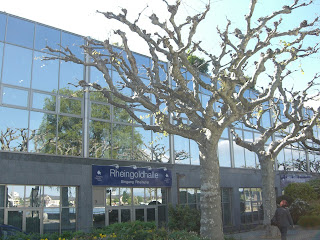 As I'm mostly working on SOA and BPM support with Java inside Eclipse (as part of the JWT project), this combination is really perfect for me!

So, it could not be better, if we wound not have heard that Bjorn Freeman-Benson, one of the first people you think about when the name "Eclipse Foundation" is mentioned, will resign working for the foundation already from at the end of this month! So, this is a really a pity, as Mike Milinkovich in the name of the Eclipse foundation announced. One can't think about EclipseCon without Bjorn! So the Eclipse Forum Europe starts with one happy and one sad eye and it seems that between all the sun, the first cloud comes up.
 As I'm mostly working on SOA and BPM support with Java inside Eclipse (as part of the JWT project), this combination is really perfect for me!
So, it could not be better, if we wound not have heard that Bjorn Freeman-Benson, one of the first people you think about when the name "Eclipse Foundation" is mentioned, will resign working for the foundation already from at the end of this month! So, this is a really a pity, as Mike Milinkovich in the name of the Eclipse foundation announced. One can't think about EclipseCon without Bjorn! So the Eclipse Forum Europe starts with one happy and one sad eye and it seems that between all the sun, the first cloud comes up.
Abonnieren
Posts (Atom)
